
Effects of precursors composition on characteristics of organic-inorganic Methyl Ammonium Lead Trihalide Perovskite-based thin films
Keywords:
Mixed halide perovskites, organo-metallic perovskites, energy bandgaps, crystallites, morphological properties, mixed compositionAbstract
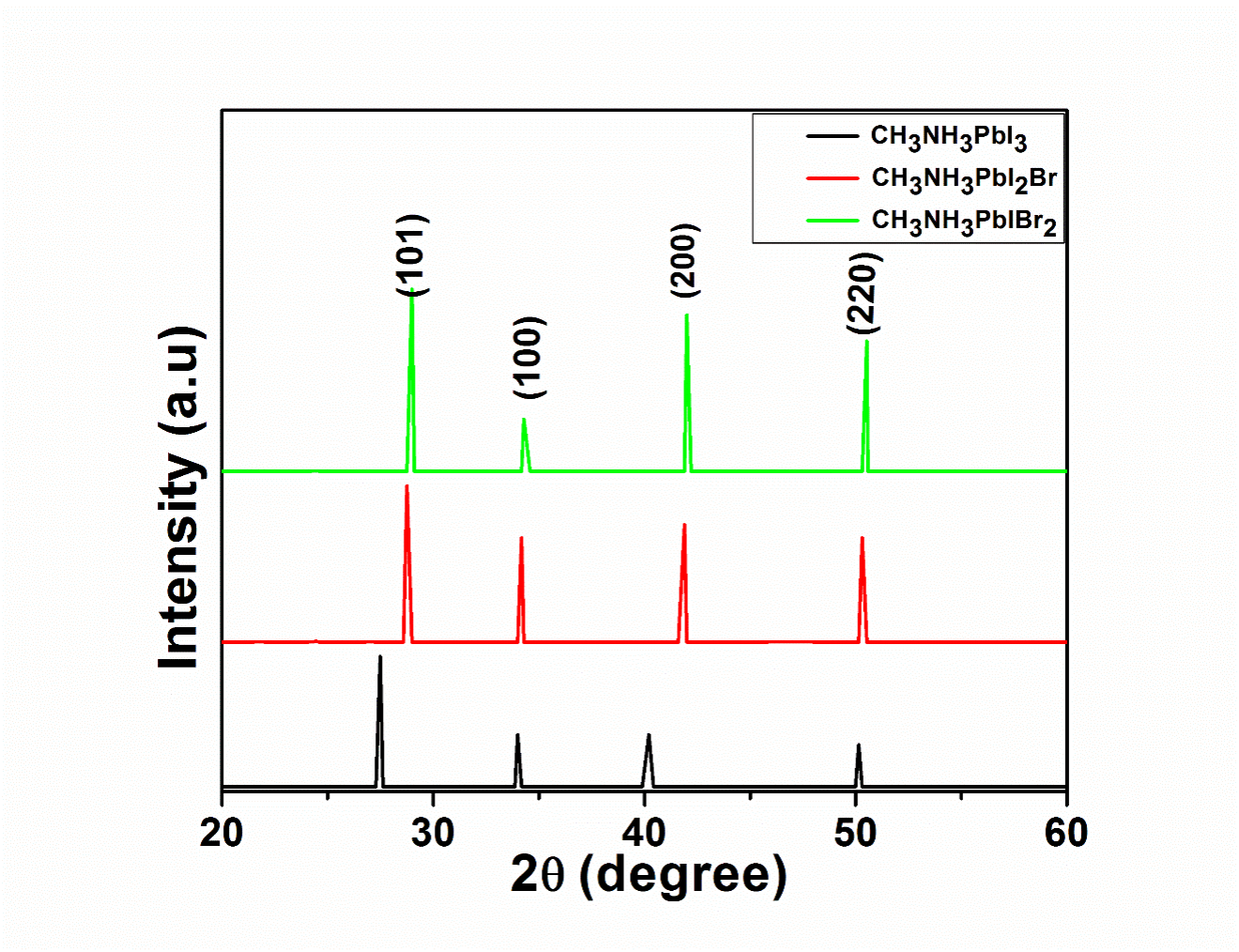
Precursors compositional engineering is considered as one of the viable methods of manipulating the characteristics of the mixed halide perovskites. In this research, methyl ammonium lead triiodide perovskites (CH3NH3PbI3) was synthesized through solution-based processing and deposited on ITO glass substrates using spin coating method. Additionally, the effects of mixed composition of precursors on the deposited films were evaluated by partial replacement of iodine (I) anion with bromine (Br) on CH3NH3Pb(I1−xBrx)3 perovskite with Br compositions for x = 0.33 and x = 0.66. The deposited films were characterized using X-ray Diffraction (XRD), Fourier Transform Infrared (FTIR) Spectrometry, Ultraviolet-visible Spectrophotometry, Scanning Electron Microscopy (SEM), Transmission Electron Microscopy (TEM) and Solar Simulator to study the structural, optical, morphological and optoelectronic properties of the films. The average crystallites of ∼7.94, ∼7.70 and ∼7.62 nm were calculated for CH3NH3PbI3, methyl ammonium lead diiodide bromide (CH3NH3PbI2Br) and methyl ammonium lead iodide dibromide (CH3NH3PbIBr2) respectively. In addition, the energy bandgaps of 1.63 eV, 1.91 eV and 1.94 eV were extrapolated for CH3NH3PbI3, CH3NH3PbI2Br and CH3NH3PbBr2I respectively. The results from J-V curves show the Jsc values of 9.9, 9.2 and 8.6 mAcm−2, FF values of 67.00, 58.20 and 54.2%, Voc values of 0.55, 0.54 and 0.52, and PCE values of 3.50, 3.33 and 3.00% were calculated for CH3NH3PbI3, CH3NH3PbI2Br and CH3NH3PbBr2I, respectively. The results show that partial replacement of I anion with Br on CH3NH3Pb(I1−xBrx)3 perovskite with Br compositions for x = 0.33 and x = 0.66 did not improve the functionality of the methyl ammonium lead triiodide perovskite material.
Published
How to Cite
Issue
Section
Copyright (c) 2025 Simeon Amole, Oluwaseun Adedokun, Olusola Akinrinola, Olumuyiwa Aderemi Oyekanmi, Festus Akintunde Ojeniyi, Adekunle Kazeem Dauda, Ayodeji Oladiran Awodugba

This work is licensed under a Creative Commons Attribution 4.0 International License.
How to Cite
Similar Articles
- Ignatius Nwoyibe Ogbaga, Henry Friday Nweke, Persuasive power of artificial intelligence-generated ads: exploring online behaviour among Gen Z internet users in Nigeria , African Scientific Reports: Volume 4, Issue 3, December 2025
- Oyesiji Cornelius Oyeyemi, Shekwonyadu Iyakwari, Stephen Ewoma Obrike, Nanlir Geoffrey Jangfa, Geobotanical and Biogeochemical Prospecting Method of Complex Sulphide Ore of Pb-Zn-Cu-Ba in Abuni-Adudu areas of the Middle Benue Trough, Nigeria , African Scientific Reports: Volume 2, Issue 2, August 2023
- R. Hamood, Samia Jamal, Zina A. Al Shadid, Mechanical Characterization of Armchair and Zigzag Single-walled Carbon Nanotube , African Scientific Reports: Volume 1, Issue 1, April 2022
- J. Lawal, A. A. Tyovenda, H. Lawal, M. U. Sarki, J. A. Lawal, D. A. Ismaila, D. S. Igba, Measurement and characterization of ambient air pollutants in selected industrial areas of Kaduna, Nigeria , African Scientific Reports: Volume 5, Issue 2, August 2026
- D. Raymond, T. P. Pantuvo, A. Lydia, J. Sabo, R. Ajia, An Optimized Half-Step Scheme Third derivative Methods for Testing Higher Order Initial Value Problems , African Scientific Reports: Volume 2, Issue 1, April 2023
- Abidah Amir, Awais Ahmad, Shah Zeb, Siti Ainor Mohd Yatim, Farah Aini Abdullah, A delay differential approach with sensitivity analysis for tuberculosis transmission and control , African Scientific Reports: Volume 5, Issue 2, August 2026
You may also start an advanced similarity search for this article.