
Anthropometric variables, physiological parameters and physical activity levels of undergraduate students from the University of Fort Hare, South Africa
Keywords:
Anthropometrics, Body mass index, Blood pressure, Physical activity, University studentsAbstract
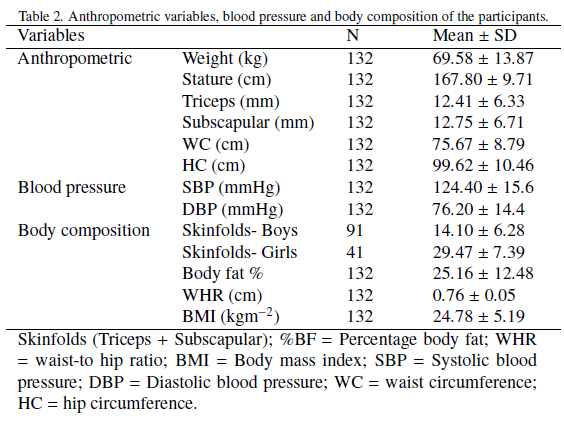
The aim of this study was to evaluate the anthropometric variables, physiological parameters and physical activity levels of undergraduate students. 132 undergraduate students aged 18 – 25 years from the University of Fort Hare who signed the consent forms participated in this cross-sectional study. Anthropometric variables were assessed using the International Society for the Advancement of Kinanthropometry (ISAK) standard procedures. Physical activity (PA) levels were evaluated using the international physical activity questionnaire – long form (IPAQ-LF). Blood pressure (BP) was measured using a digital BP monitor (Omran Corporation, model no-IA2 HEM 7001-c-1). 8 %, 59.8 %, 28.0 % and 11.4 % are underweight, normal weight, overweight and obese, respectively. The skinfolds, percentage body fat and body mass index (BMI) of female participants were significantly (p < .001) higher than the male participants with a large effect sizes (d ≤ -2.3). Likewise, the waist-to hip ratio was significantly (p < .001) higher in male participants with a large effect size (d = 1.2). The result also showed that 59.8 % participants had normal BP, 13.6 % had high systolic blood pressure (SBP), 6.8 % had high diastolic blood pressure (DBP), 7.6 % had prehypertension and 12.1 % had hypertension, respectively. Male participants had higher SBP while female participants had higher DBP which had no significant (p > 0.001) effect and with low effect sizes (d= 0.1). Again, 72.1 % of participants do not engage in sufficient PA of 300 mins per week which is reflective of less physical activities as compared to the recommended standard (of 300 minutes of moderate-intensity aerobic PA per week) by the world health organization (WHO). We recommend an urgent intervention programs that will help improve the PA levels, reduce unhealthy BMI and BP levels of university students.
Published
How to Cite
Issue
Section
Copyright (c) 2025 Nikita Phuza, Sibulele Moni, Iviwe Sigojo, Ayamnkele James, Mere Idamokoro, Leon Van Niekiek

This work is licensed under a Creative Commons Attribution 4.0 International License.
How to Cite
Similar Articles
- Nigerian Society of Physical Sciences, Introducing article numbering to African Scientific Reports , African Scientific Reports: Volume 2, Issue 1, April 2023
- Terver Sombo, Titus Nyitar, Emmanuel Vezua Tikyaa, Tertsea Igbawua, Investigation of diurnal road traffic noise in Makurdi metropolis, Benue State, Nigeria , African Scientific Reports: Volume 4, Issue 2, August 2025
- Ahmed Mahi Shuaibu, Bathymetric survey and volumetric analysis of Bakolori dam reservoir North West Nigeria , African Scientific Reports: Volume 3, Issue 2, August 2024
- Aondugu Alexander Tyovenda, Theresa Jummai Usman, Emmanuel Vezua Tikyaa, Air quality impact of open tyre burning: analysis of particulate matter and gases , African Scientific Reports: Volume 5, Issue 1, April 2026
- Eno Chongs Mantu, Olukayode Olugbenga Orole, Aleruchi Chuku, Femi Gbadeyan, Tosin Okunade, Assessment of mycotoxin presence and distribution in maize grains across North central states of Nigeria , African Scientific Reports: Volume 4, Issue 3, December 2025
- Augustine A. Abong, Samuel I. Ugar, Geophysical investigation of leachate contamination around selected dumpsites in Calabar, Nigeria , African Scientific Reports: Volume 5, Issue 2, August 2026
- Oladunjoye Peter Olabode, Tokunbo Sanmi Fagbemigun, John Oluwabemiwo Olaleye, Oluwaseyi Elijah Ayobami, Tamarantare Favour Preh, Oluwatimilehin Moses Fadare, Geophysical investigation of groundwater potential in parts of Afao Ekiti, Southwestern Nigeria , African Scientific Reports: Volume 5, Issue 2, August 2026
You may also start an advanced similarity search for this article.