
The impact of cognitive and emotional factors on user experience in HCI
Keywords:
Human–Computer Interaction (HCI), User Experience (UX), Cognitive Factors, Emotional Design, Affective ComputingAbstract
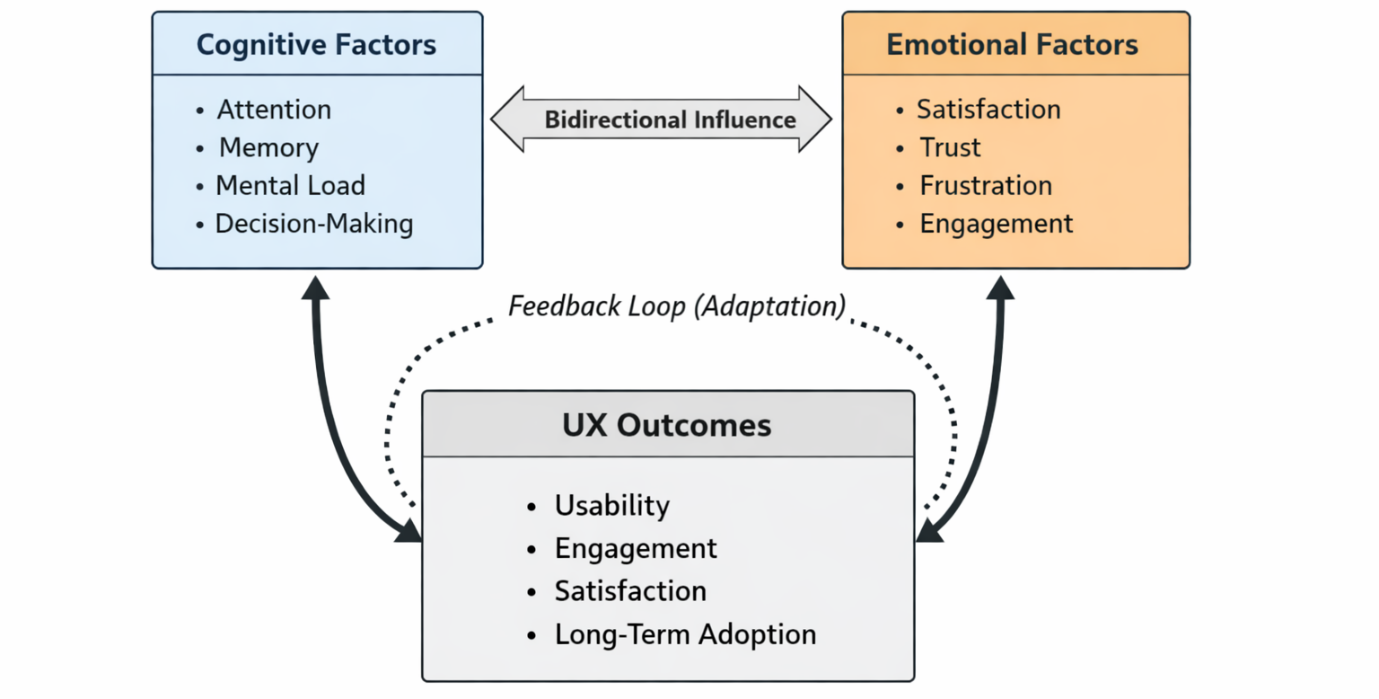
This paper discusses how cognitive and emotional factors affect user experience (UX) in human-computer interaction (HCI). It examines how users' cognitive processes, including perception, attention, memory and decision-making, interact with emotional reactions, including satisfaction, trust and engagement, to shape the quality of interaction. Drawing on principles from cognitive psychology and affective computing, the study shows that effective HCI design extends beyond functionality and efficiency to include emotional appeal and user satisfaction. The paper emphasises that reducing cognitive load, maintaining interface consistency and using intuitive visual cues improve understanding and task performance. At the same time, integrating affective design principles, including aesthetic appeal, empathy and personalisation, contributes to greater emotional satisfaction and user motivation. It also assesses approaches for measuring UX, including usability testing, heuristic evaluation, affective feedback and physiological emotion monitoring, to capture the cognitive and emotional dimensions of interaction. The findings indicate that combining cognitive ergonomics and emotional intelligence in interface design can produce more adaptive, engaging and human-centred systems. By balancing mental efficiency with positive emotional experience, designers can create technologies that promote trust, empathy and long-term user engagement. Overall, this study supports the value of balancing rational and affective design to develop interactive systems that are useful, efficient, meaningful and emotionally satisfying.
Published
How to Cite
Issue
Section
Copyright (c) 2026 Ike Joseph Mgbeafulike, Ogochukwu C. Okeke, Osita Miracle Nwakeze, Anthony T. Umerah, Uju Cynthia Nwabudike, Chikaodili Chidi-Onuigbo

This work is licensed under a Creative Commons Attribution 4.0 International License.
How to Cite
Similar Articles
- Tosan Peter Omayone, Ibrahim Aliyu, Grace Iyabo Adebayo-Gege, Impact of high protein diet on the formation and healing of L-arginine induced acute pancreatitis in male wistar rats , African Scientific Reports: Volume 4, Issue 1, April 2025
- A. A. Ibiyemi, J. I. Lawal, S. K. Aminu, A. G. Adewole, B. M. Akinroye, A. C. Adeniran, O. A. Abulude, pH treatment on the optical and structural properties of niobium vanadium pentoxide nanoparticles for optoelectronics and energy storage applications , African Scientific Reports: Volume 4, Issue 2, August 2025
- Shadreck Muyambo, Jack A Urombo, Garry K. Masoha, Livingstone Jenya, A mathematical framework for assessing food fraud intentions , African Scientific Reports: Volume 4, Issue 3, December 2025
- O. B. Ayoade, M. O. Raji, A. A. Akindele, K. J. Yusuf-Mashopa, M. F. Abdulrauf, I. A. Raji, F. B. Musah, Hyperparameter optimisation for support vector machine-based disease detection in maize leaf variants , African Scientific Reports: Volume 4, Issue 3, December 2025
- Abayomi Ajayi, Olaniyi Olayiwola, Fadeke Apantaku, Idowu Osinuga, Oluwaseun Wale-Orojo, Predicting the needs of people living with a disability using the two-level logit-skewed exponential power model , African Scientific Reports: Volume 3, Issue 2, August 2024
- Ebenezer O. Ayoola, Victor N. Enwemiwe, Hilda O. Erhenhi, Clement C. Obi, Agboola A. Adebowale, Eric Esiwo, Joyce A. Onokpasa, Robert B. Ikomi, Acute toxicity of Oreochromis niloticus fingerlings exposed to effluent from Delta State University, Abraka Nigeria boys hostel , African Scientific Reports: Volume 3, Issue 2, August 2024
- Denis U. Ashishie, Endurance O. Obi, Osowomuabe Njama-Abang, Ahena I. Bassey, Transformative approach in Lassa fever diagnostics: an innovative integrative strategy for early detection and outcome prediction , African Scientific Reports: Volume 4, Issue 3, December 2025
- Mutiat A. Ogunrinde, Yusuf B. Yusuf, A culturally aware NLP approach for fake-news detection in Nigerian online media using BERT , African Scientific Reports: Volume 5, Issue 2, August 2026
- Sunday Sani Daku, Victor Bulus Diyelmak, Ernest Anayo Okafor, Assessment of potentially harmful elements in mine spoils of Jos and environs, central Nigeria , African Scientific Reports: Volume 4, Issue 3, December 2025
- Adenike Adegoke-Elijah, Theresa Omolayo Ojewumi, Kudirat Oyewumi Jimoh, ECG anomaly detection: a deep learning perspective with LSTM encoders , African Scientific Reports: Volume 4, Issue 3, December 2025
You may also start an advanced similarity search for this article.