
Integrated geophysical, geochemical and remote sensing assessment of soil corrosion susceptibility in Sabon Gida, Katsina State, Northwestern Nigeria
Keywords:
Soil corrosivity, Electrical resistivity, Analytical hierarchy process, Corrosion susceptibility, Remote sensingAbstract
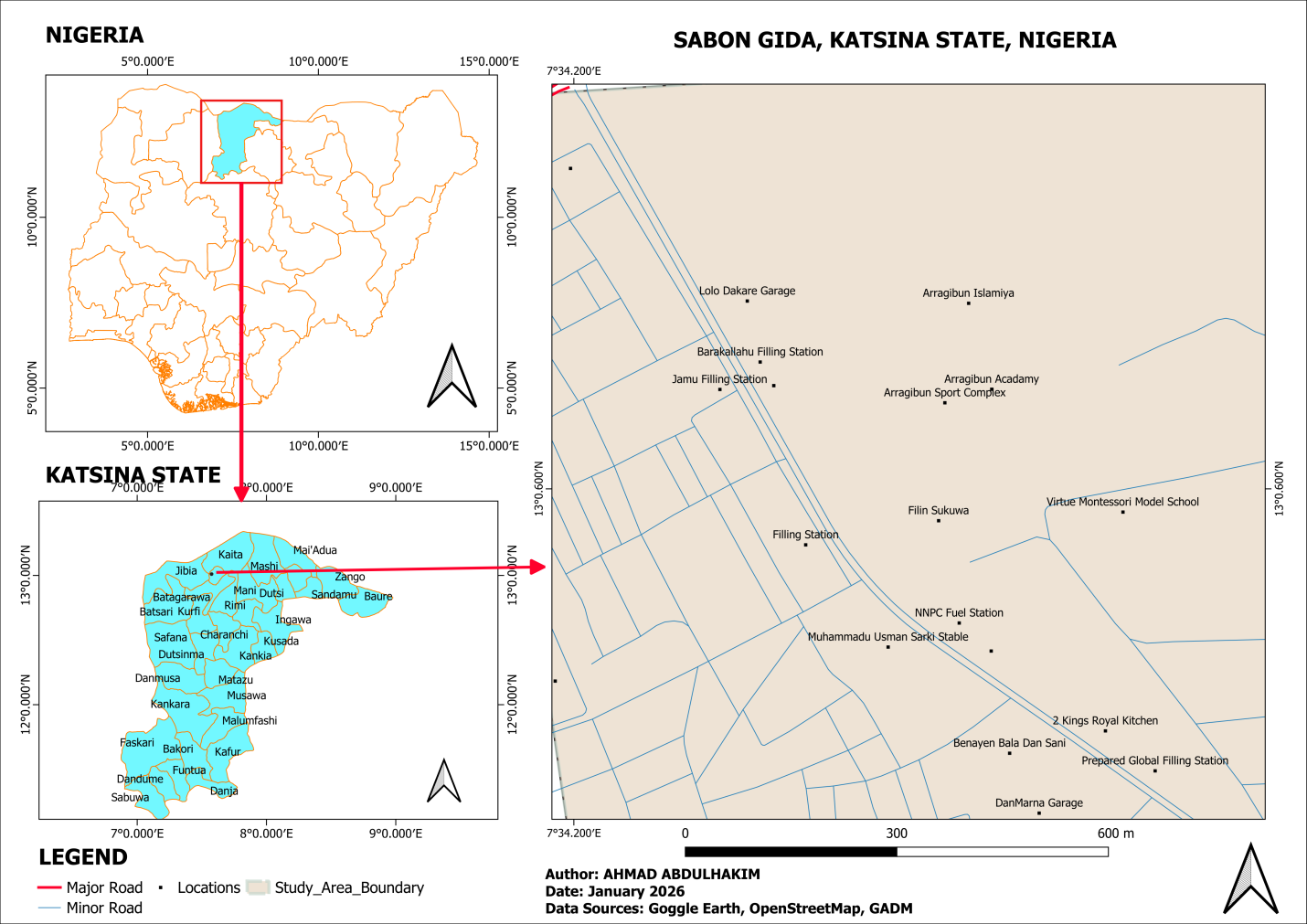
One of the major factors affecting the longevity of buried metallic infrastructure, including pipelines, underground tanks, and foundation materials, is soil corrosivity. This study integrated geophysical, geochemical, and remote sensing data to assess soil corrosion susceptibility in Sabon Gida, Katsina State, Nigeria. The Schlumberger array configuration was used to acquire vertical electrical sounding (VES) data at 44 stations to evaluate subsurface resistivity and corrosion potential. Soil samples were collected at depths of 0--0.5, 0.5--1.0, 1.0--1.5, and 1.5--2.0 m from five representative VES locations corresponding to different resistivity classes and analyzed for pH. Sentinel-2 Level-2A imagery was processed to derive the normalized difference vegetation index (NDVI), normalized difference water index (NDWI), bare soil index (BSI), and salinity index (SI). The analytical hierarchy process (AHP) and weighted sum model (WSM) were integrated within a geographic information system (GIS) to generate a corrosion susceptibility index (CSI) map. The interpreted resistivity values ranged from 23.11 to 1779 Ω m, indicating significant spatial variation in subsurface conductivity. Soil pH values ranged from 6.3 to 7.1, reflecting slightly acidic to near-neutral conditions. The remote sensing indices revealed spatial variations in vegetation cover, moisture conditions, salinity, and bare soil exposure across the study area. The resulting CSI map indicates predominantly moderate corrosion susceptibility across the study area on 2 to 3 scale of corrosion susceptibility level suggesting relatively favorable conditions for buried infrastructure. However, site-specific engineering investigations and direct corrosion measurements are recommended before installation. The integrated approach provides a more comprehensive assessment than single-parameter methods and offers valuable information for infrastructure planning and corrosion management in the study area.
Published
How to Cite
Issue
Section
Copyright (c) 2026 Akpaneno A. Francis, Ahmad Abdulhakim

This work is licensed under a Creative Commons Attribution 4.0 International License.
How to Cite
Similar Articles
- Chiagoziem Wisdom Chidiebere, Ugochukwu Aniefuna Azuka Anthonia, Natural Skin Whitening Compounds: Types, Source and Mechanism of Action: A Review , African Scientific Reports: Volume 2, Issue 1, April 2023
- Matthew Olaleke Aremu, Stephen Olaide Aremu, Ibrahim Aliyu, David Bala Passali, Munir Hussaini, Benjamin Zobada Musa, Rasaq Bolakale Salau, Amino acids profile and health attributes of Bambara groundnut (Vigna subteranea L.) and sesame (Sesamum indicum L.): a comparative study , African Scientific Reports: Volume 4, Issue 1, April 2025
- A. O. Daramola, T. J. Ajayi, O. S. Olusi, T. V. Olugbade, E. O. Aina, A. J. Folorunso, B. M. Rotimi, K. S. Okonji, Epidemiology of ABO and Rhesus blood group frequencies in a Nigerian tertiary hospital: public health and transfusion-relevant patterns , African Scientific Reports: Volume 5, Issue 3, December 2026 (In progress)
- E. A. Yerima, S. P. Maaji, C. V. Ogbodo, D. Abutu, S. A. Yakubu, F. O. Nwankwo, S. J. Aboki, J. A. Adamu, Efficient and optimal adsorptive removal of urea from agricultural effluent using acidified ball clay: optimization via response surface methodology , African Scientific Reports: Volume 5, Issue 1, April 2026
- Gabriel James, Anietie Ekong, Etimbuk Abraham, Enobong Oduobuk, Nseobong Michael, Victor Ufford, Oscar Ebong, An enhanced control solutions for efficient urban waste management using deep learning algorithms , African Scientific Reports: Volume 3, Issue 3, December 2024
You may also start an advanced similarity search for this article.