
Epidemiology of ABO and Rhesus blood group frequencies in a Nigerian tertiary hospital: public health and transfusion-relevant patterns
Keywords:
ABO blood group, Rh factor, Blood group distribution, Transfusion medicine, NigeriaAbstract
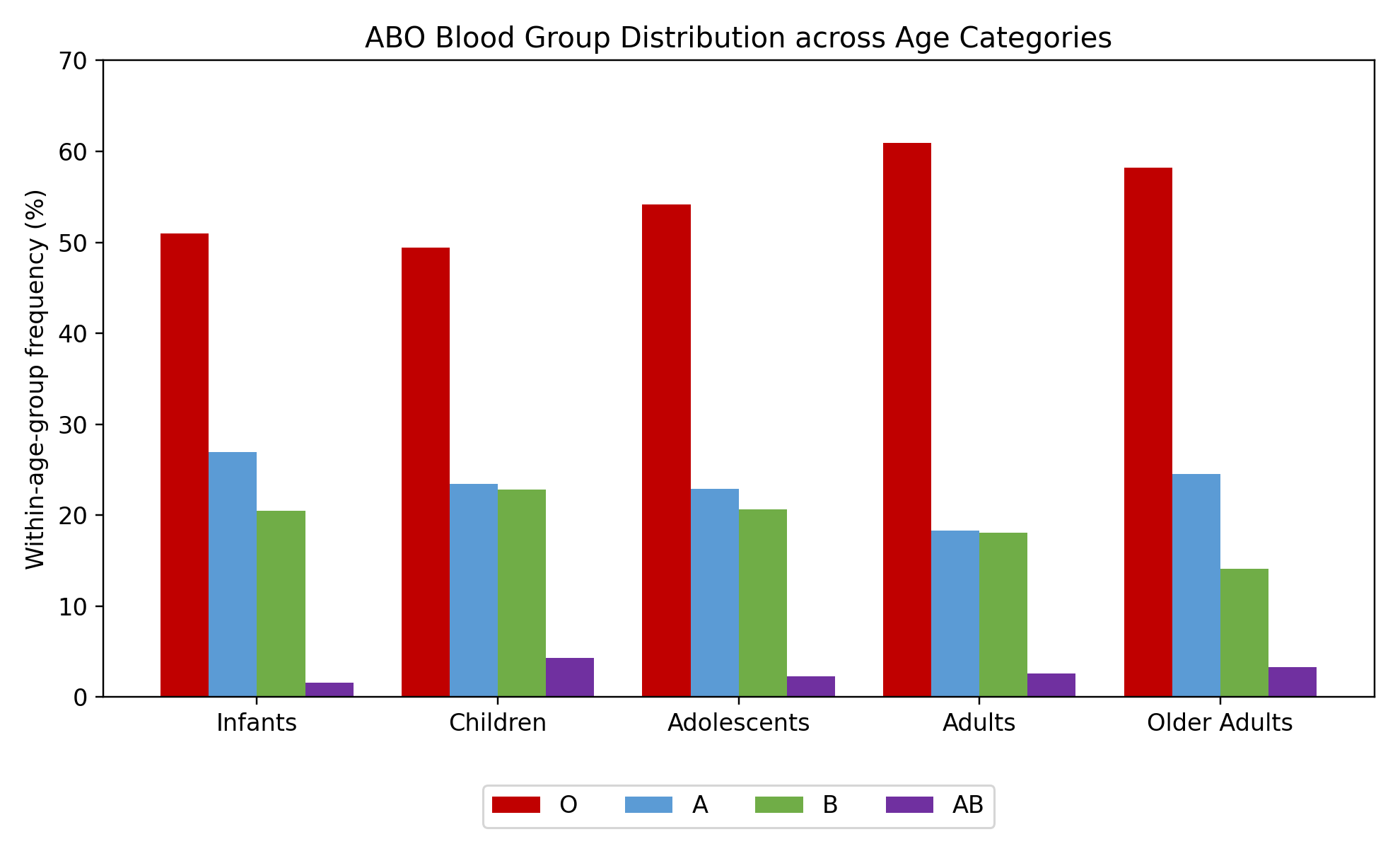
ABO and Rhesus (Rh) blood group frequencies vary by population and are relevant to transfusion compatibility and blood-bank planning. This retrospective study describes the distribution of ABO and Rh blood groups and their association with age and sex among 6,933 client records handled by the Blood Bank of Ekiti State University Teaching Hospital (EKSUTH), Ado-Ekiti, Nigeria, during 2023. The cohort comprised 3,538 males (51.0%) and 3,395 females (49.0%); adults (18--64 years) accounted for 79.3% (5,499/6,933). Blood group O was the most frequent ABO phenotype (4,094; 59.1%), followed by A (1,361; 19.6%), B (1,293; 18.7%), and AB (185; 2.7%); 93.2% of clients were Rh-positive. O-positive was the most common combined phenotype (54.9%), and AB-negative was the least common (0.2%). ABO group distribution differed significantly by age group (χ2(12) = 60.8, p < 0.001, Cramer's V = 0.05) and by sex (χ2(3) = 36.9, p < 0.001, Cramer's V = 0.07); both effect sizes were small. Rh status showed no significant association with age (χ2(1) = 0.13, p = 0.714). Blood group O was more frequent among males (62.1%) than females (55.9%), whereas A, B, and AB were modestly more frequent among females. These findings, drawn from a single tertiary-hospital client population that includes donors, transfusion recipients, and routine attendees, provide baseline data to support age- and sex-informed blood-inventory planning and donor recruitment at EKSUTH. Given the cross-sectional, hospital-based design, the findings should not be generalized to the wider Ekiti State or Nigerian population, and any inference about disease susceptibility or survival requires dedicated outcome-based studies.
Published
How to Cite
Issue
Section
Copyright (c) 2026 A. O. Daramola, T. J. Ajayi, O. S. Olusi, T. V. Olugbade, E. O. Aina, A. J. Folorunso, B. M. Rotimi, K. S. Okonji

This work is licensed under a Creative Commons Attribution 4.0 International License.
How to Cite
Similar Articles
- Ike Joseph Mgbeafulike, Ogochukwu C. Okeke, Osita Miracle Nwakeze, Anthony T. Umerah, Uju Cynthia Nwabudike, Chikaodili Chidi-Onuigbo, The impact of cognitive and emotional factors on user experience in HCI , African Scientific Reports: Volume 5, Issue 2, August 2026
You may also start an advanced similarity search for this article.